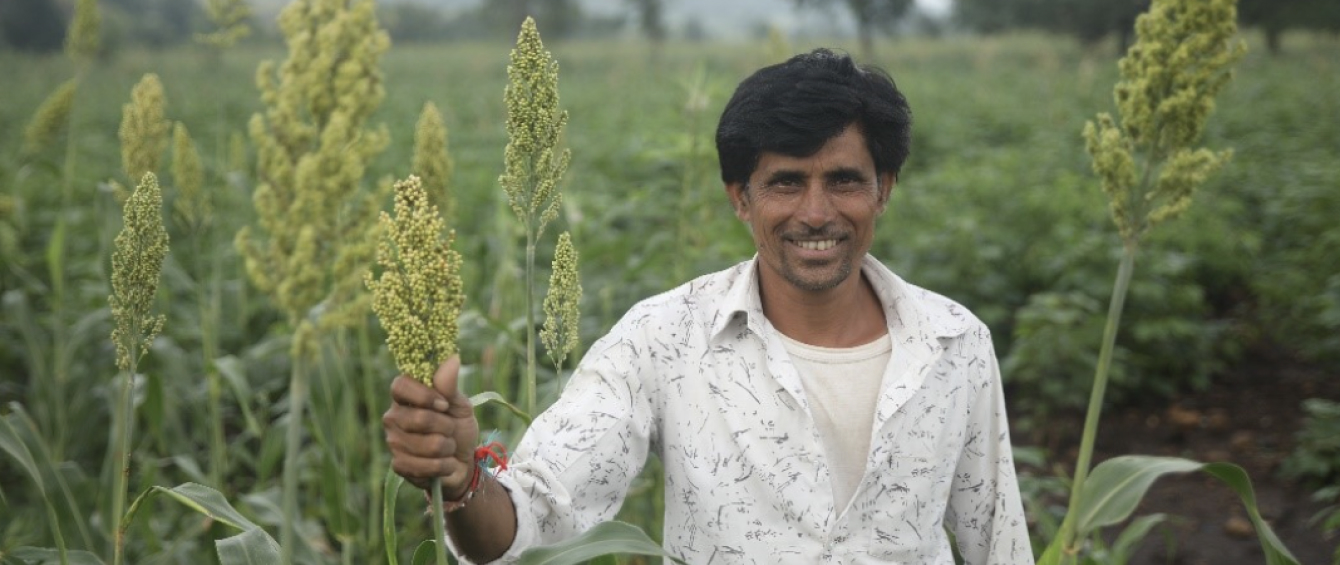
Enhancing Farming Incomes
Reliance Foundation enables rural households to enhance their incomes through farming, fishing, livestock, poultry and other means of livelihoods with approaches including:
• Equipping communities with knowledge of improved practises and support schemes
• Strengthening collectives
• Disseminating new skills, ways to reduce input costs, support in acquiring improved material/inputs/tools
• Strengthening market linkages
• Information leverage for higher income
These are part of the Integrated Value Chain Development (IVCD) initiative.
Lowering costs, increasing yields
To help increase farm incomes, Reliance Foundation works with farmers on the input side to lower costs and increase yields. Cost reduction efforts involve adopting efficient resource management practises and sustainable farming techniques that reduce dependence on supplemental inputs.
Farmers are also supported in choosing crops that are best suited to their agro-ecology. Through partnerships with agriculture research institutes, improved seed varieties are provided to farmers. By obtaining necessary information from the Reliance Foundation during the entire duration of the crop cycle, farmers are able to confidently take timely decisions related to field operations.
On the output side, farmers are supported in post-harvest primary or secondary processing, where there is scope, through farmer collectives. These collectives, either mentored or supported by Reliance Foundation, procure produce from the farm-gate, help farmers utilize technologies and overcome labour shortage, provide grading or sorting services, process the produce and ensure fair compensation to their member farmers.
Through these collectives, farmers also get an opportunity to explore new markets for their produce. They are made aware of government social security schemes and supported in availing of them.
Adequate water and healthy soils are key ingredients to good yields. Farmers are supported in getting their soils tested and encouraged to enhance soil health through cost-effective and environmentally sustainable initiatives. Water availability for agriculture is improved by community and individual efforts to harvest rainwater and improve groundwater recharge. Tailored water harvesting plans for each village help increase water harvesting capacity and ensure availability of soil moisture during rabi and summer seasons.
So far, more than 1,413 lakh cubic metres of water harvesting capacity has been created across India. This has helped farmers in cropping more than once during the year and increase their earnings.
Raising poultry, livestock and fishing incomes
Reliance Foundation supports households in rearing high-yielding breeds of livestock and poultry. Best practises in livestock rearing and feed management are shared and capacity to adopt these practises is built. After initial handholding, households are supported in scaling up their activities.
Information about weather and disease alerts, and expert prescriptions for vaccination and treatment provided at free livestock camps help households mitigate livestock related losses.
For marine fisherpersons, information about potential fishing zones helps increase the chances of a good catch in the ocean. PFZ information also leads fisherpersons safely and quickly to areas where fish is available. By reducing the fuel expended, this information contributes to lowering the environmental footprint of fisherfolk.
Promoting non-farm livelihoods
Given the inherent risks in farming and allied activities, Reliance Foundation encourages households to take up non-farm activities alongside farming. Landless and tenant farming households as well as farm labourers are also supported in diversifying their incomes.
These activities are entrepreneurial in nature. Tailoring, groceries, confectionary, printing and data entry, other vending and service enterprises are some of avenues for alternate livelihoods. By leveraging government grant and loan schemes through self-help groups, rural households can start, sustain and scale up alternate livelihood activities.
Page Content


More on Rural Transformation

Securing Livelihoods by Improving Climate Resilience
A changing climate will significantly affect agricultural and related livelihoods. The Government of India projects that rice yields under rain-fed and irrigated conditions could fall by as much as 20% and 3.5%, respectively, by 2050 in the absence of interventions. For wheat, a 19.3% reduction is projected.
Reliance Foundation takes a multipronged approach with rural communities to help smallholder farm households enhance their resilience to pests, diseases and inter-seasonal climate uncertainties while improving their capacity to adapt to long-term climate related changes through its Climate Resilience for Sustainable Development (CR4SD) initiative.
Adopting resilient crop varieties
Farm households with small landholdings cultivating conventional varieties of a single crop are more vulnerable to climate shocks than households that cultivate resilient varieties. Reliance Foundation encourages farmers to cultivate resilient varieties with traits like a short maturity cycle, heat, drought or salinity tolerance, and pest and disease resilience.
Diversifying crop production
Intensive monocropping renders farmers more vulnerable to climate shocks including inter-seasonal dry spells, pests and diseases. To help farmers shift from monocropping, farmers are introduced to crop rotation with pulses, oilseeds and millets along with the incorporation of horticulture and floriculture for enhanced incomes.
Better natural resources management
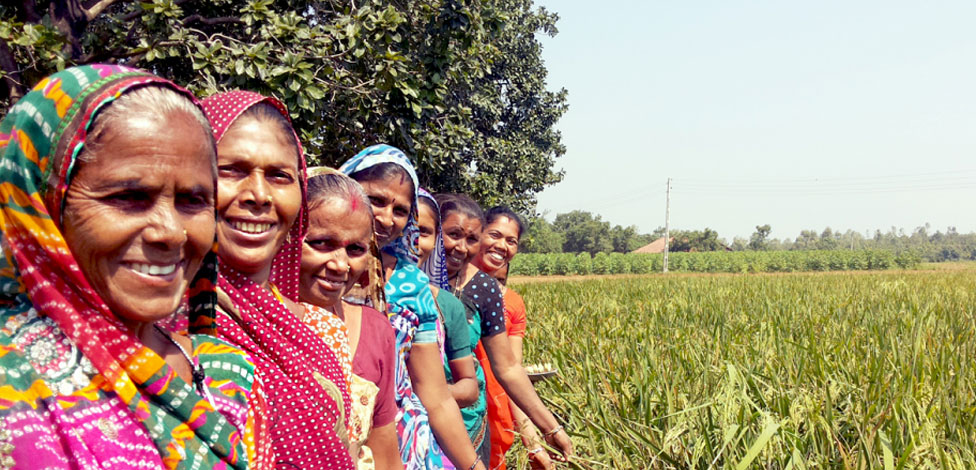
Reliance Foundation works with rural communities to enhance crop yields by supporting communities in the sustainable use of land and water. Landscape approaches like contour bunding, land levelling and terracing are advocated alongside practices like raised bed cultivation that can sustain or improve crop yields while reducing erosion.
Partnering with entire villages, Reliance Foundation encourages strengthening the water harvesting capacity within communities by supporting the creation of new water harvesting structures and revitalising existing structures. Farmers are supported in adopting efficient irrigation practises like sprinkler and drip irrigation to encourage sustainable water use.
Rural diversification
A household’s resilience is higher when sources of income are diverse. To enhance resilience to log-term climate related challenges, households are supported in diversifying into agri-allied income generating activities like livestock rearing, poultry, fishing and non-farm, skill-based microentrepreneurial activities.
Households are supported in acquiring resilient and market-preferred breeds of livestock and poultry. Through regular capacity enhancement programmes, scientifically-proven practises are shared to help communities in caring for their livestock. Livestock medical camps are regularly organised to help households get timely veterinary treatment. The camps assume greater importance during and after extreme weather events.
Information services for farmers
Smallholder farming communities are supported with information throughout a crop cycle. Weather forecasts and advisories that help inform decisions regarding the times of sowing, intercultural operations, pest and disease management and harvest. Besides ensuring desired yields, the information helps to mitigate the fallout from climate shocks.
Reliance Foundation supports marine fishing communities by providing fishers crucial ocean state forecast information and related advisories. This helps fisherpersons navigate the ocean in a safe and informed manner, lowering risk to their lives and livelihoods. Weather information also helps both marine and inland fisherfolk to safeguard their equipment, ponds and fish during extreme events like cyclones and floods.
Page Content
More on Rural Transformation
Rural Transformation
This farmer doubled his farm income with just one simple change
 Team Reliance Foundation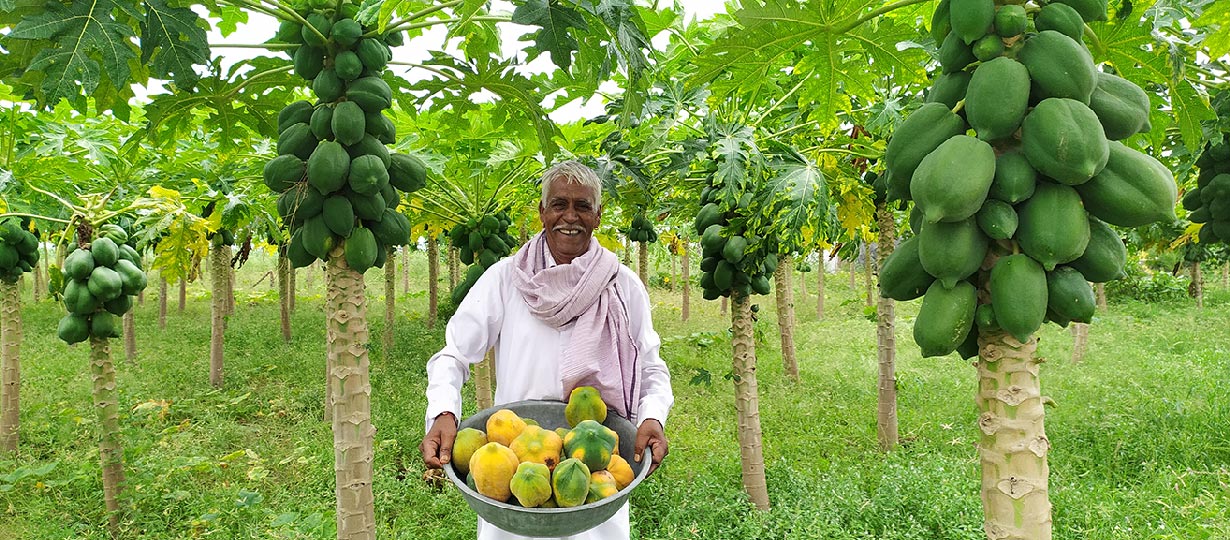
Jai Narayan Bairwa from Juwar Village of Rajasthan’s Sawai Madhopur district was practicing traditional farming cultivating wheat, mustard, gram and maize along with a few seasonal vegetables for commercial purposes on in his 3.5 ha land. In spite of his sustained hard work, income was low and inadequate.
In 2019, Jai Narayan came in contact with Reliance Foundation’s awareness and capacity building initiatives, where he was introduced to improved agricultural and horticultural practices.
After attending these sessions, Narayan was convinced about the various benefits of horticulture. He expressed interest in Red Lady Papaya cultivation. With support from Reliance Foundation, he was able to plant 200 papaya saplings on 0.125 ha of his land by adopting improved farming practices. For higher yield, he made use of drip irrigation and other organic ingredients. Between November 2020 and September 2021, he reaped around 75 quintals that he sold for Rs. 2000 per quintal locally and earned over Rs. 1 Lakh. Out of the 200 planted saplings, 50 were pestilence stricken, therefore the revenue came from 150 plants (Average 50 Kg fruit per plant).
This positive experience gave him the confidence to plant 700 more saplings in his nursery across another 0.375 ha in March 2021. Content, Jai Narayan thanks Reliance Foundation for introducing him to a new highly profitable livelihood initiative. He says, “I am expecting to earn a minimum of Rs 4-5 lakhs through papaya farming in total 0.5 hectare land. I encourage other farmers to bring in the same changes; this will earn them more than they are earning now, bringing strength and security to the livelihood”
Soon, another bounty of papayas will be ripe for harvest. An inspiration for his fellow villagers, Jai Narayan Bairwa motivates other farmers in his community to adopt the changes with help from Reliance Foundation.
Click here to read more about our work on Rural Transformation.
Page Content
More Stories
Rural Transformation
Reliance Foundation proves the power of farmers’ collectives at Jasdan, Gujarat
- 28 November, 2017
- Gujarat
- 4 min read
Farmer Producer Company formed by groundnut farmers of Saurashtra create significant milestones in Kharif 2017
Reliance Foundation enabled Farmer Producer Company (FPC) at Jasdan, a tehsil in Rajkot district of Gujarat achieved a 128 percent growth in turnover in Kharif 2017. The FPC was set up in August 2016 and has touched this business milestone in its second season of operation. The FPC initially formed with just 700 members has almost 1500 members today, expecting to reach 2600 members by end of 2017.
Establishment of Farmer Producer Companies (FPCs) is one of the key interventions under the Rural Transformation programme of Reliance Foundation. The FPCs are part of RF’s effort to strengthen the value chain of farm produce, enhance its marketability, help the marginal farmers and livestock owners realise better prices and thus, achieve income security for themselves. Reliance Foundation helps train farmers to independently manage these companies in the long term. Since its inception in 2010, RF has so far formed 19 FPCs – better known as Producer Companies (PCs) – to empower farmers across the country, benefitting over 21,000 families. These companies, taken together, had transacted over 4,500 metric tonnes of farm and non-farm produce till the end of last season, raising farmers’ incomes significantly and augmenting the farmers’ ability to govern their own institutions effectively.
However, this season has been special. In Kharif 2017, the turnover of this FPC alone has more than doubled from Rs.7 crore (2016-17) to Rs.16 crore (2017-18).
Compared to the open market, where the farmers are compelled to sell groundnut at Rs.3450-3500 per quintal, the company has succeeded in fetching the farmers an extra margin of Rs.1000 per quintal by getting them registered in the government system, sourcing groundnut from them as per quality norms and depositing to government-designated warehouses at an MSP of Rs.4450 + a bonus of Rs.50 announced by Government of Gujarat.
The surplus added to the village economy by the FPC’s business went up from Rs.1.5 crore (2016-17), to more than Rs.3.5 crore (2017-18), as the quantity of groundnut handled by Jasdan FPC till Nov.20 this year stood at 35,733 quintals, a rapid increase of 14,885 quintals over the previous week.
The Jasdan FPC has been transacting on behalf of Jasdan farmers in collaboration with Gujarat State Co-Operative Cotton Federation Limited (GUJCOT). The members’ interest and community participation in the FPC at Jasdan ensured that they got a procurement centre to procure Groundnut Pods at Minimum Support Price (MSP) for NAFED (National Agricultural Co-Operative Marketing Federation) for second consecutive year and also got the nod from NAFED to start another centre in November 2017 from RF project villages at Vankiya, which will help more farmers to get associated with the company.
In the past, RF has been recognised for its outstanding contribution in the field of building FPCs across the country. Recently, Shri Arjun Ram Meghwal, Union Minister of State for Finance and Corporate Affairs, felicitated RF with the Krishi Pragati Award instituted by the National Commodities Derivatives Exchange (NCDEX) for its ‘Outstanding Contribution as a Resource Institution for Promoting FPCs’ while Jamwa Ramgarh FPC (Rajasthan) was recognized as Most Promising Producers’ Company.
Page Content
